
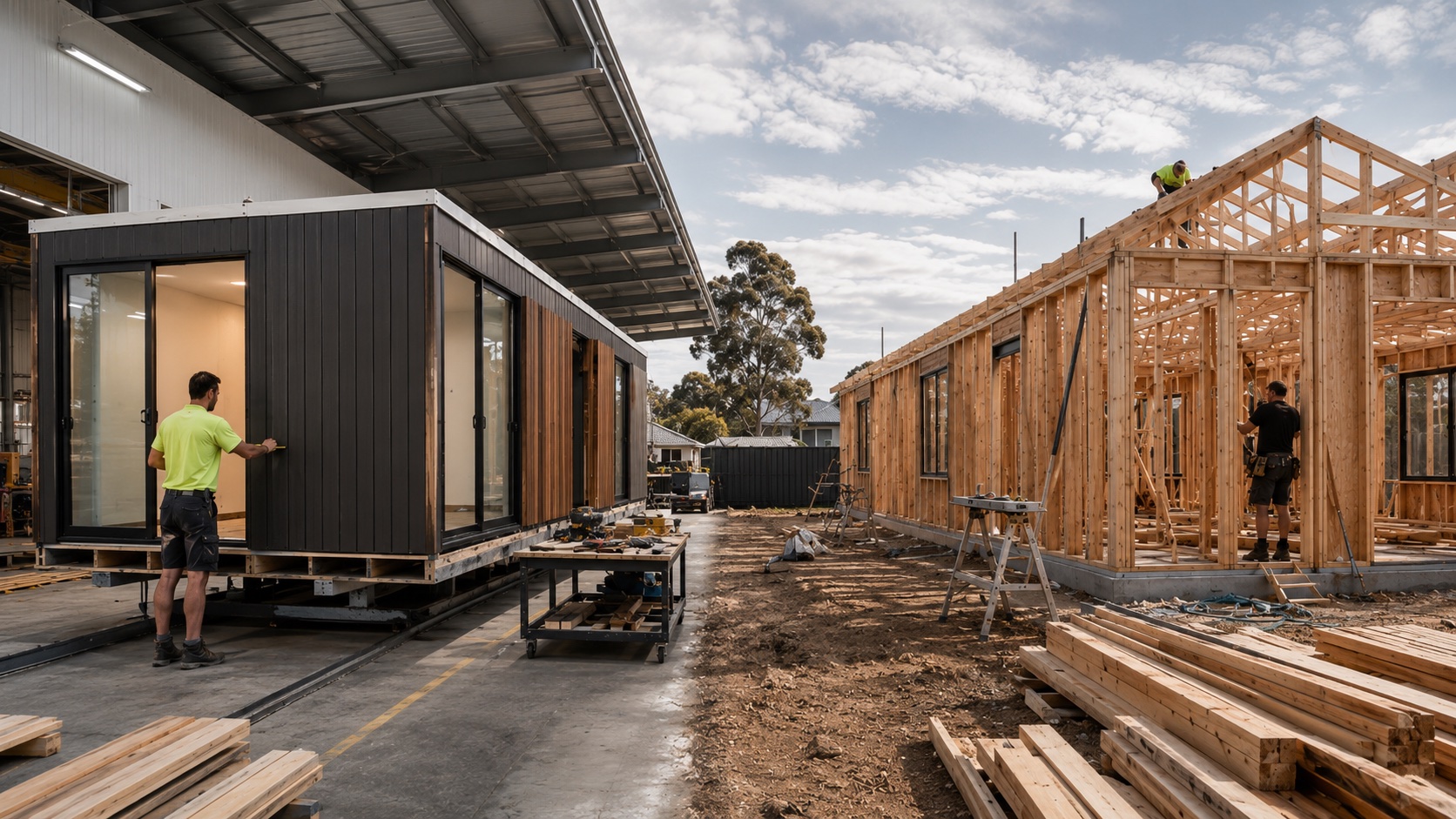
The Honest Comparison

Modular vs Traditional Build

We manage both. That makes us the wrong people to hype either — and the right people to tell you which one fits your site, your budget and your deadline.

Comparison Matrix

Seven Factors, Side by Side

Performance MetricModular ConstructionTraditional Build
Build time✓ Modular wins: Factory build runs parallel to site works; up to 50% faster overall.Sequential trades on site; weather and trade availability set the pace.
Cost certainty✓ Modular wins: Fixed factory contract locks most cost early, cutting overrun risks.Variations and prime-cost items keep budgets moving throughout construction.
Weather & site risk✓ Modular wins: 80–90% of the build happens indoors inside controlled environments.Every wet week is a lost week; high exposure to extreme weather delays.
Quality control✓ Modular wins: Repeatable factory QA, inspected at workstation stations.Quality varies with the skill and oversight of the specific crew on the day.
Design flexibilityModule dimensions and transport limits constrain architectural forms.✓ Traditional wins: Near-unlimited customization options.
Finance complexityRequires specific contract structures to fit bank pre-installation rules.✓ Traditional wins: Mature, standardized loan products from all major lenders.
Best suited forStandard-format dwellings, regional sites, tight timelines, repeatable products (SDA).Complex architectural designs, bespoke structures, steep blocks, difficult site access.
Cost Dynamics

Where the Money Actually Goes

A modular budget shifts money out of on-site labour and program overruns, into factory contract and logistics (transport, crane, install). Total cost can be up to 20% lower — but only when the site suits and logistics are managed well. A hard-access site can hand that saving straight to the crane company.

The question is never "is modular cheaper?" It's "is modular cheaper on YOUR block?" — and that's a feasibility question, not an opinion.

Custom Budget Analysis

We analyze transportation clearances, crane size needs, and civil preparation costs to ensure you don't overspend.

Decision Tools

Get the Answer for Your Site — Both Tracks, One Report.

Our Two-Track Feasibility runs your block through both scenarios: modular and traditional, with costs, timelines, finance implications and risk flags side by side. One document. One clear recommendation.

Two-Track Feasibility Includes:

  • ✓ Modular transport clearance assessment
  • ✓ Estimated crane day lift study and cost limits
  • ✓ Dynamic cashflow models comparing interest savings
  • ✓ Specific zoning constraints for both methods

Two ways to build. One right answer for your block.

Don't guess which development method maximizes your returns. Let us run the real-world data checks.

Book Free Consultation