
Development Brief Checklist for SA Property Owners
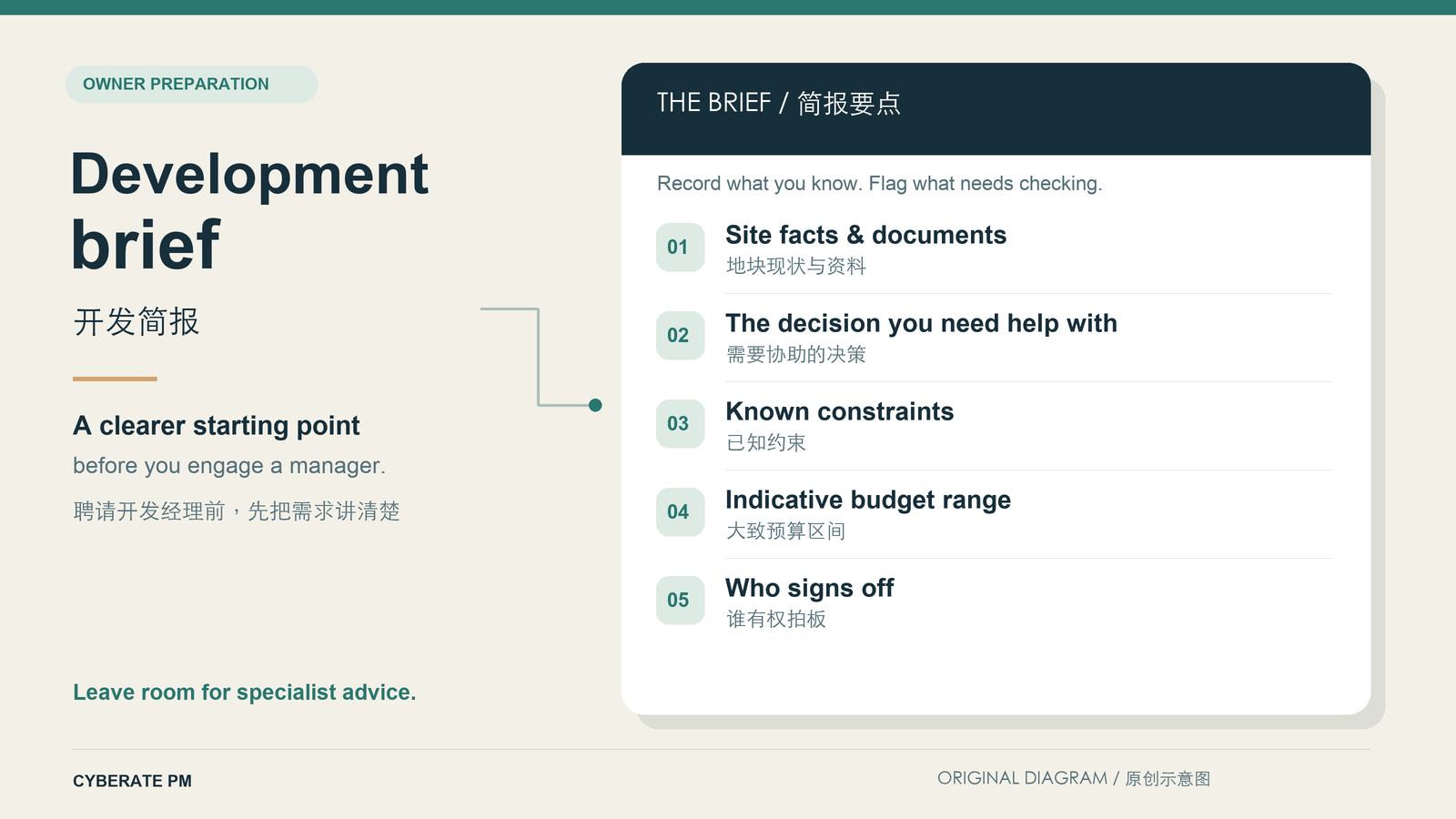
If you're about to engage a development manager or project manager in South Australia and you don't yet have a short written brief, write one before you call anyone — not after the first meeting. A vague verbal brief is one of the most common ways projects end up with mismatched proposals, a consultant working from assumptions you never agreed to, and a scope argument three months in. A development brief doesn't need to be long. It needs to settle five things — site facts, your goals, your known constraints, an indicative budget range, and who actually makes the final call — before a consultant starts building a scope of work around guesses.
This article sets out what a brief should lock down before engagement, what it should deliberately leave open, and how it interacts with the decision about whether you need a development manager, a project manager, or both.
Why a vague brief costs more later than writing one now
A brief exists to give the person you engage a fixed starting point, rather than letting them infer one. The UK's Royal Institution of Chartered Surveyors (RICS) makes this point in its guidance on construction project briefs: a brief should be "detailed and comprehensive" and proportionate to the project's scale, and it should identify every stakeholder with a stake in the outcome and what each of them actually needs from the project — not just the obvious sign-off name (RICS, Why proper briefs are key to successful projects, Built Environment Journal, 23 January 2024). The same guidance pushes back on a common owner habit: setting a budget ceiling before any feasibility work has tested whether it's realistic, then asking consultants to "make it fit" that number. RICS's point runs the other way — use early feasibility and cost planning to arrive at a budget range that is actually grounded in the site and the brief, rather than treating an arbitrary figure as fixed and the scope as the thing that flexes.
The cost of skipping this is not hypothetical. If three consultants price the same "project" from three different mental models of what you're asking for, you don't get three comparable quotes — you get three different projects, and you won't know that until you're comparing scope, not price, line by line. Reworking a scope after engagement is slower and more expensive than reworking a brief before it, because the second round now has to unwind whatever the first consultant already assumed and started on.
What a brief needs to settle before you engage anyone
1. Site facts and what you can actually hand over
Before approaching a development manager or project manager, gather what you already hold on the site — title documents, any existing survey, prior plans, correspondence with Council or agencies, and photos — and say plainly which of it is confirmed and which is an assumption you haven't verified. An Australian property-development brief framework built around this idea (the "DECIDE" brief, from property-education publisher Think Property Club) puts it directly: "A capable developer defines the decision, supplies the evidence and asks the professional to investigate issues within their scope" (Think Property Club, How to Brief Property Development Specialists in Australia, 2 September 2026). The useful discipline here is separating what you know from what you're guessing — a consultant told "this easement is unconfirmed, please check it" works very differently from one handed a brief that quietly treats an assumption as a fact.
2. What decision you actually need help with
Name the decision the engagement needs to support — not the project in general, but the specific call you can't make without the input. "Should I pursue this site" is a different brief to "how do I sequence this subdivision" or "who manages the build once the DA is through." The same Think Property Club framework treats this as the core of a useful brief: describe the site and the proposed strategy, then state the decision that needs specialist input, rather than asking a consultant to broadly validate whether a project is a good idea. This also shapes whether you're looking for a development manager or a project manager in the first place — our development manager vs project manager explainer sets out where that line usually sits, and it's worth reading before you finalise who the brief is even going to.
3. Constraints you already know about
List anything that already narrows your options — a heritage overlay you've been told applies, a family member who needs to sign off, an existing tenancy, a timeline driven by something outside the project, such as loan terms or a settlement date. These aren't always comfortable to disclose, but a consultant working without them will build a scope that ignores a constraint you knew about the whole time, and that gap surfaces later as rework.
4. An indicative budget range, not a fixed number
State a range, and say whether it's a hard ceiling or a starting point pending feasibility — don't present an arbitrary figure as fixed before anyone has tested it against the site. This is consistent with the RICS guidance above: a grounded budget comes out of early feasibility and cost planning, not the other way around. It's also why this article doesn't state fee percentages or dollar figures itself — development management fee structures vary with what's actually in scope, and our development management fees explainer sets out why the same headline percentage can mean very different things depending on what it covers. Bring that question to your own proposal comparison, not to this brief.
5. Who actually has decision-making authority
Say, in writing, who signs off — on the brief itself, on scope changes, and on the engagement generally. If there's more than one owner, a trust, a family arrangement or a joint venture behind the decision, name the person (or the process) the consultant should treat as authoritative, and confirm that person has actually agreed to it before the brief goes out. Project-charter practice uses the same idea for larger projects generally: a brief that doesn't name who can approve scope and budget changes tends to produce exactly that confusion later, once a change is actually on the table. Our what a development manager does explainer covers how that coordinating role sits between you and the rest of the project team once engagement starts — that coordination works better when authority was settled in the brief, not worked out mid-project.
What a brief should deliberately leave open
A brief that tries to specify the design solution, or names the exact consultant for every discipline, usually does more harm than good. The DECIDE framework above is explicit about this: the brief should state the decision and supply the evidence, then "ask the professional to investigate issues within their scope" — not pre-empt the answer. RICS's guidance makes a related point from the consultant's side: a good adviser knows when to bring in other expertise rather than straying outside their own knowledge area — something that depends on the brief leaving room for that judgement, rather than dictating the method before anyone qualified has looked at the site.
In practice, that means your brief should leave open: the specific design response to your site constraints, which named consultant handles which discipline (unless you already have a strong reason to specify one), and the detailed methodology a specialist uses to answer the question you've posed. What it should not leave open is the decision itself, the facts you already hold, your constraints, your budget range, and who signs off — those are yours to settle, not theirs to guess at.
A short self-check before you send the brief
Before sending a brief to a development manager, project manager or consultant, you should be able to answer each of these in a sentence or two:
- What specific decision does this engagement need to support?
- What do I actually know about the site, and what am I assuming but haven't verified?
- What constraints already apply, even the inconvenient ones?
- What's my budget range, and is it a ceiling or a starting point?
- Who signs off on this brief, on scope changes, and on the engagement overall — and have they agreed to that?
If you can't answer one of these yet, that's a sign to resolve it first, or to say explicitly in the brief that it's outstanding and ask the consultant to flag it rather than assume an answer.
Where this fits before you call anyone
None of this replaces your own legal, tax or planning advice on the site itself — a brief organises what you already know and what you need decided; it doesn't substitute for the specific professional advice your situation requires. If you'd rather talk through a brief before sending it out, or want a second opinion on whether a development manager or project manager is the right first call for your project, our team runs feasibility and consult conversations for South Australian owners at exactly this stage — see our feasibility service or book a consult.
About the author
Cyberate PM
Expert property development and project management insights.
Not Sure Whether Your Site Stacks Up?
Send us the address and your goal. We will identify the first planning, buildability and feasibility questions before you commit further capital.