Research
We Did Not Guess How Long Approvals Take. We Measured 20,000 of Them.
Cyberate PM contributed to Chapter 2 of the Australia Housing Market White Paper 2026, published by Australian Residential Construction Institute (RESI). It analysed more than 20,000 residential subdivision planning consent applications lodged through PlanSA across all 18 Adelaide metropolitan councils between January 2022 and June 2025.
The question it set out to answer is the one every landowner asks us first: what actually decides whether an approval takes two months or ten?
Published by the Australian Residential Construction Institute (RESI). Reproduced with permission — visit RESI for the full report →The Evidence Base
What was measured
South Australia is unusually well suited to this kind of analysis. Because every application runs through PlanSA, the state produces a consistent, comparable record of pathway allocation, stage progression and information requests — which makes it possible to see where time is actually consumed rather than where people assume it is.
SA planning consent applications analysed
Residential subdivision consent applications lodged through PlanSA between January 2022 and June 2025.
Adelaide metropolitan councils covered
Proportionally sampled across all 18 metropolitan councils, so council-level variation is measurable.
Typical land division, lodgement to new titles
The council decision itself takes only 30–60 business days of that; conditions, works and title clearances take the rest. Sequenced in parallel, a division lands at the short end. Range per Land Services SA and SA industry guidance.
Annual shortfall against the National Housing Accord
Australia completed about 176,000 dwellings in 2023–24 against the 240,000 a year implied by the Accord.
Source: Australian Residential Construction Institute (RESI), Australia Housing Market White Paper 2026. Chapter 2 draws on original research by Percy Zhang, Dr Ruidong Chang, Dr Joy Fang, Dr William Jiang — “Unlocking the Building Pipeline in a Housing Crisis: Data Mining South Australia’s Planning Approval Processes” — recipient of the Best Paper Award, 48th AUBEA International Conference. Used with permission.
Finding 01
The pathway your application lands in matters more than almost anything else
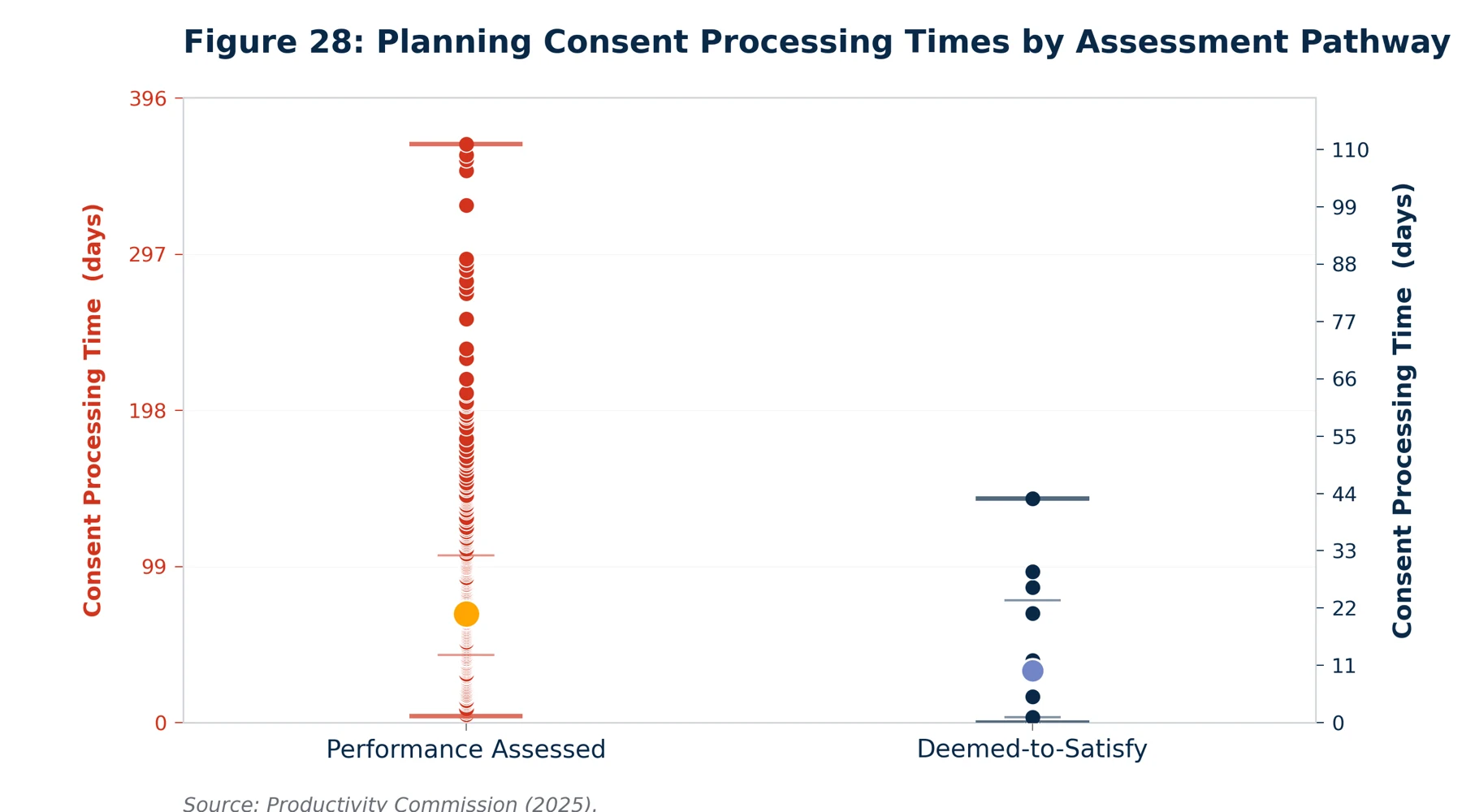
Deemed-to-satisfy applications resolve in a tight, short band. Performance-assessed applications spread across a far wider range, with a long tail running past a year. Same state, same system, same year — a different pathway.
This is why the first thing we do on any site is establish which pathway the proposal will realistically fall into, and what would have to change about the scheme to move it. That question is worth more to your programme than any amount of chasing the council afterwards.

Source: Australian Residential Construction Institute (RESI), Australia Housing Market White Paper 2026. Chapter 2 draws on original research by Percy Zhang, Dr Ruidong Chang, Dr Joy Fang, Dr William Jiang — “Unlocking the Building Pipeline in a Housing Crisis: Data Mining South Australia’s Planning Approval Processes” — recipient of the Best Paper Award, 48th AUBEA International Conference. Used with permission.
Finding 02
Every external referral costs you time
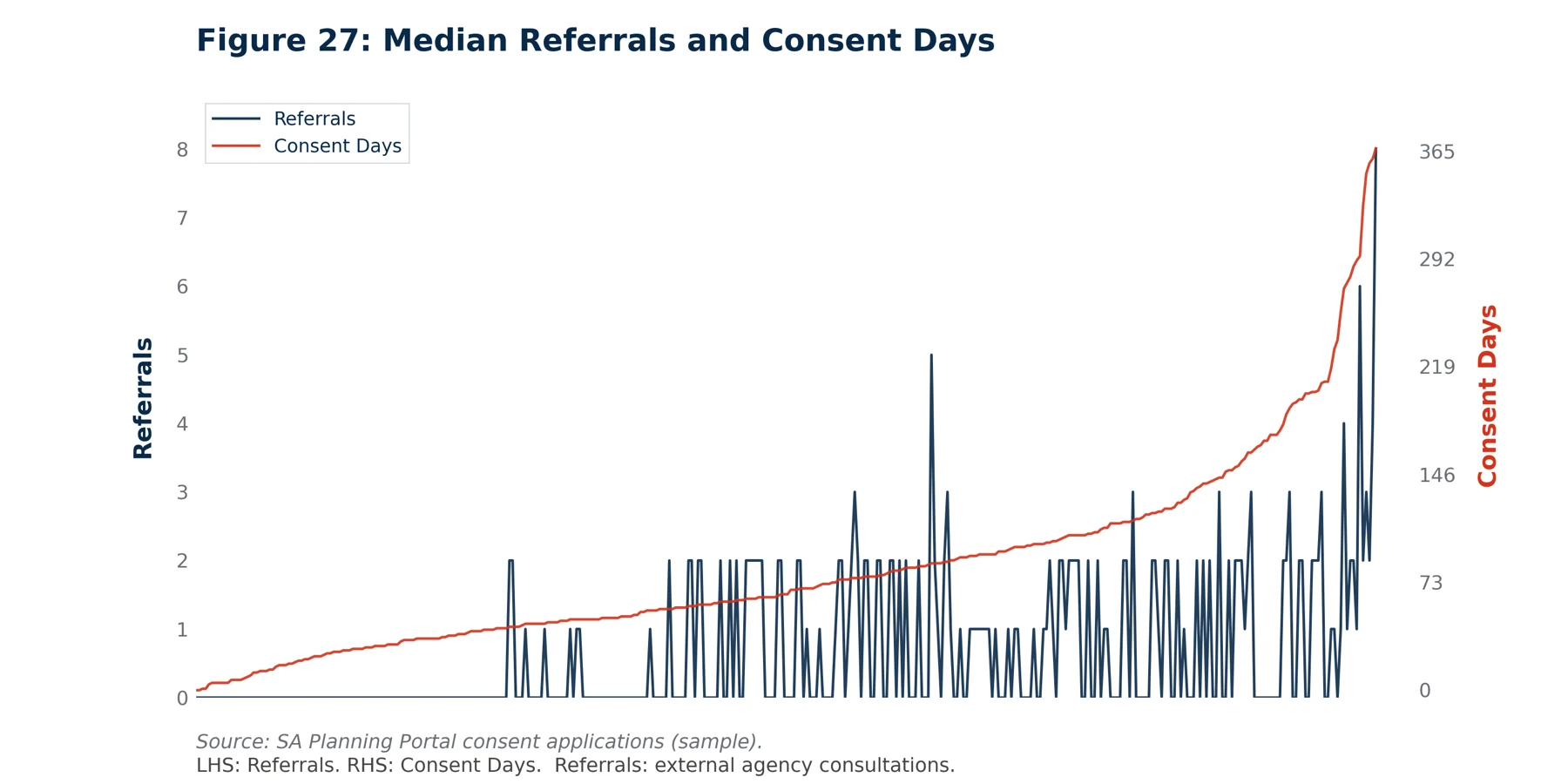
As the number of external agencies consulted on an application rises, consent timelines lengthen with it. Each referral introduces another queue, another response window and another opportunity for the file to go back and forth.
Referrals are often unavoidable. What is avoidable is discovering them after lodgement. Identifying the likely triggers before you lodge, and preparing the supporting material each agency will ask for, is the difference between one round and three.

Source: Australian Residential Construction Institute (RESI), Australia Housing Market White Paper 2026. Chapter 2 draws on original research by Percy Zhang, Dr Ruidong Chang, Dr Joy Fang, Dr William Jiang — “Unlocking the Building Pipeline in a Housing Crisis: Data Mining South Australia’s Planning Approval Processes” — recipient of the Best Paper Award, 48th AUBEA International Conference. Used with permission.
All Findings
What held up, and what did not
The analysis tested each driver on its own, then tested them together to see which ones survive once everything else is accounted for. Several widely held assumptions did not survive.
The pathway decides the timeline
Assessment pathway is the strongest structural driver of how long consent takes. Performance-assessed applications cluster at materially longer consent-day ranges than deemed-to-satisfy ones.
Verification predicts what follows
Verification time is an early warning signal. Applications that spend longer being verified as complete consistently end up with longer overall timelines.
Every referral adds time
Referrals are associated with steadily longer consent timelines. As the number of external agencies involved rises, so does elapsed time.
Notification is a delay multiplier
Public notification and referrals persist as delay multipliers even after controlling for everything else — they add iteration risk and specialist input.
Location matters less than people think
Location-based assumptions weaken once controls are applied. Zone and place variables become less significant when workflow triggers and proposal traits are accounted for.
Two things that did not matter
Two things people expect to matter did not show a clear standalone effect in this dataset: tree removal, and lodging near a public holiday.
Source: Australian Residential Construction Institute (RESI), Australia Housing Market White Paper 2026. Chapter 2 draws on original research by Percy Zhang, Dr Ruidong Chang, Dr Joy Fang, Dr William Jiang — “Unlocking the Building Pipeline in a Housing Crisis: Data Mining South Australia’s Planning Approval Processes” — recipient of the Best Paper Award, 48th AUBEA International Conference. Used with permission.
Why It Matters
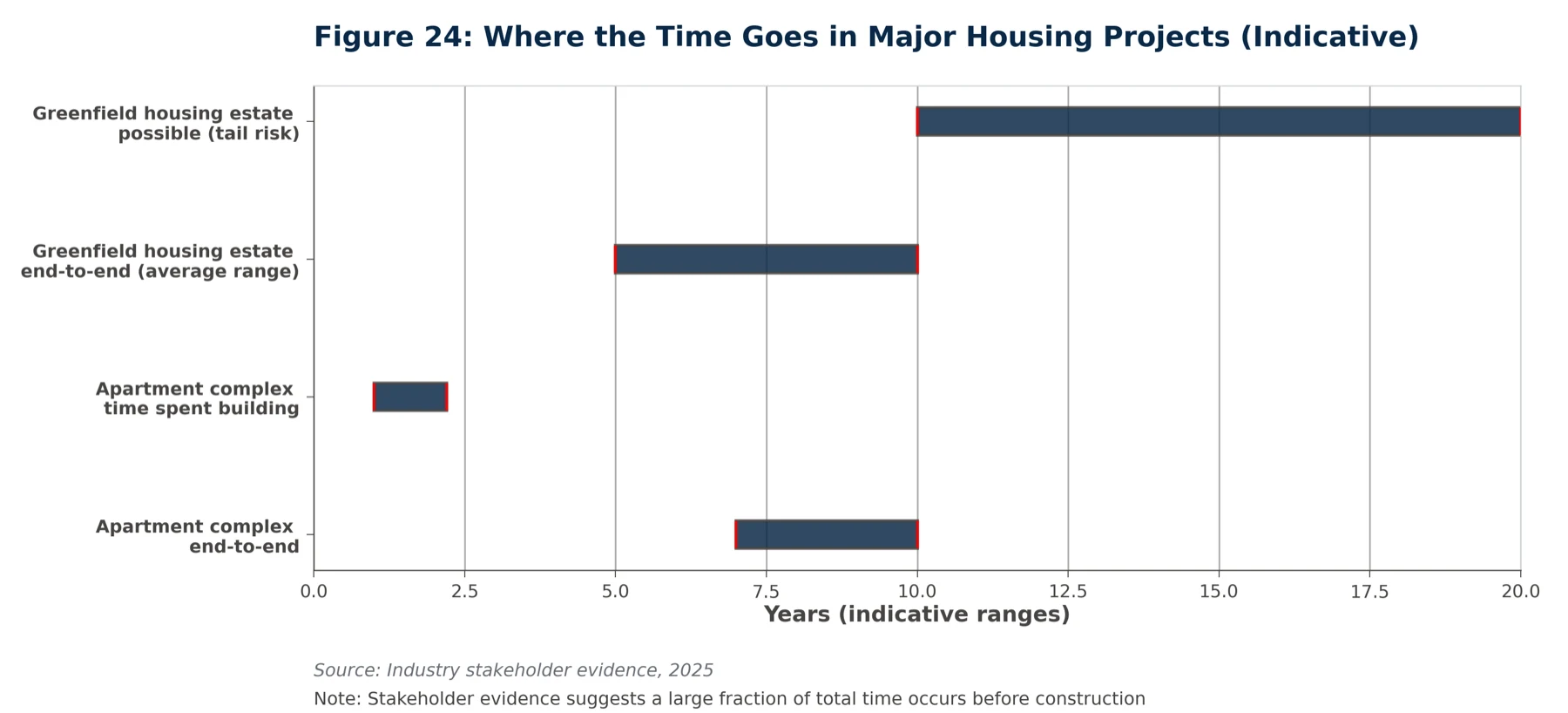
Most of a project’s timeline happens before anyone starts building
Even for a straightforward land division, the window from lodgement to new titles commonly runs six to twelve months — while the council decision itself takes only 30–60 business days of that. The difference is sequencing: conditions, works and clearances, one after another or side by side. The construction programme is not where projects are usually lost.
That is the whole argument for having a development manager: the part of the programme that decides your outcome is the part before the builder arrives, and it is the part most owners have no way to run themselves.

Source: Australian Residential Construction Institute (RESI), Australia Housing Market White Paper 2026. Used with permission.
The Playbook
What the evidence says to do differently
The paper sets out five practice shifts for small and medium developers. Read them as a description of what a development manager is for — each one is work that has to happen before lodgement, by someone whose job it is to see it coming.
Source: Australian Residential Construction Institute (RESI), Australia Housing Market White Paper 2026. Chapter 2 draws on original research by Percy Zhang, Dr Ruidong Chang, Dr Joy Fang, Dr William Jiang — “Unlocking the Building Pipeline in a Housing Crisis: Data Mining South Australia’s Planning Approval Processes” — recipient of the Best Paper Award, 48th AUBEA International Conference. Used with permission.
Want this applied to your site?
Send us the address and what you are thinking of doing. We will tell you which pathway it is likely to fall into, what would probably trigger a referral, and what that means for your timeline.
Book a 30-Minute ConsultationCiting this research
Writing about approval timeframes? You are welcome to cite the findings on this page. Please credit RESI as publisher and link to the original report.
Percy Zhang, Dr Ruidong Chang, Dr Joy Fang, Dr William Jiang (2026). Unlocking the Building Pipeline in a Housing Crisis: Data Mining South Australia’s Planning Approval Processes. In Australia Housing Market White Paper 2026. Australian Residential Construction Institute (RESI). https://resi.org.au/knowledge/flagship-reports
Sources, attribution and limitations
The empirical analysis in the white paper draws on public datasets from Australian Bureau of Statistics (ABS), Reserve Bank of Australia (RBA), CoreLogic, PropTrack, SGS Economics and Planning, and South Australia’s Online Planning and Design Code (PlanSA).
Chapter 2 is an authorised citation from “Unlocking the Building Pipeline in a Housing Crisis: Data Mining South Australia’s Planning Approval Processes”, original research by Percy Zhang, Dr Ruidong Chang, Dr Joy Fang, Dr William Jiang, synthesised for the white paper by Nicole Yang. Cyberate PM reproduces this material with RESI’s permission.
The findings describe how the South Australian planning system behaved across this sample and period. They are general information, not advice about a specific site, and they do not predict the outcome of any individual application. Academic affiliations cited in the white paper do not imply institutional endorsement.
Source: Australian Residential Construction Institute (RESI), Australia Housing Market White Paper 2026. Chapter 2 draws on original research by Percy Zhang, Dr Ruidong Chang, Dr Joy Fang, Dr William Jiang — “Unlocking the Building Pipeline in a Housing Crisis: Data Mining South Australia’s Planning Approval Processes” — recipient of the Best Paper Award, 48th AUBEA International Conference. Used with permission.
Councils: see how your outcomes compare.
This dataset covers all 18 Adelaide metropolitan councils. If you sit inside one of them, we can show you how your pathway mix, density outcomes and timing compare with the other 17 — the part you cannot see from inside.